Among the interesting things William Aprill of Aprill Risk Consulting has been saying lately are some comments he made about mental health and guns on Paul Carlson’s Safety Solutions Academy Podcast (Ep. 444 from 10 October 2018).
One of the challenges of addressing mental health issues, Aprill and Carlson observe in their conversation, is the tremendous stigma attached to being “mentally ill” in our society. (This despite the prevalence of diagnosed mental illness.) Because it is stigmatized, few people want to talk about it. But not talking about it perpetuates the stigma.
Here Aprill astutely observes that one of the lessons of the #MeToo movement is “it is important for people to hear that normal people, that people they know, have been the victim of sexual assault, sexual abuse. I don’t think a MeToo movement about mental health would be a bad thing either. And I don’t it’s wrong to think that people in the firearms self-defense community who have histories of mental health problems that they’ve entered into recovery for [should] talk about them a little more honestly.”
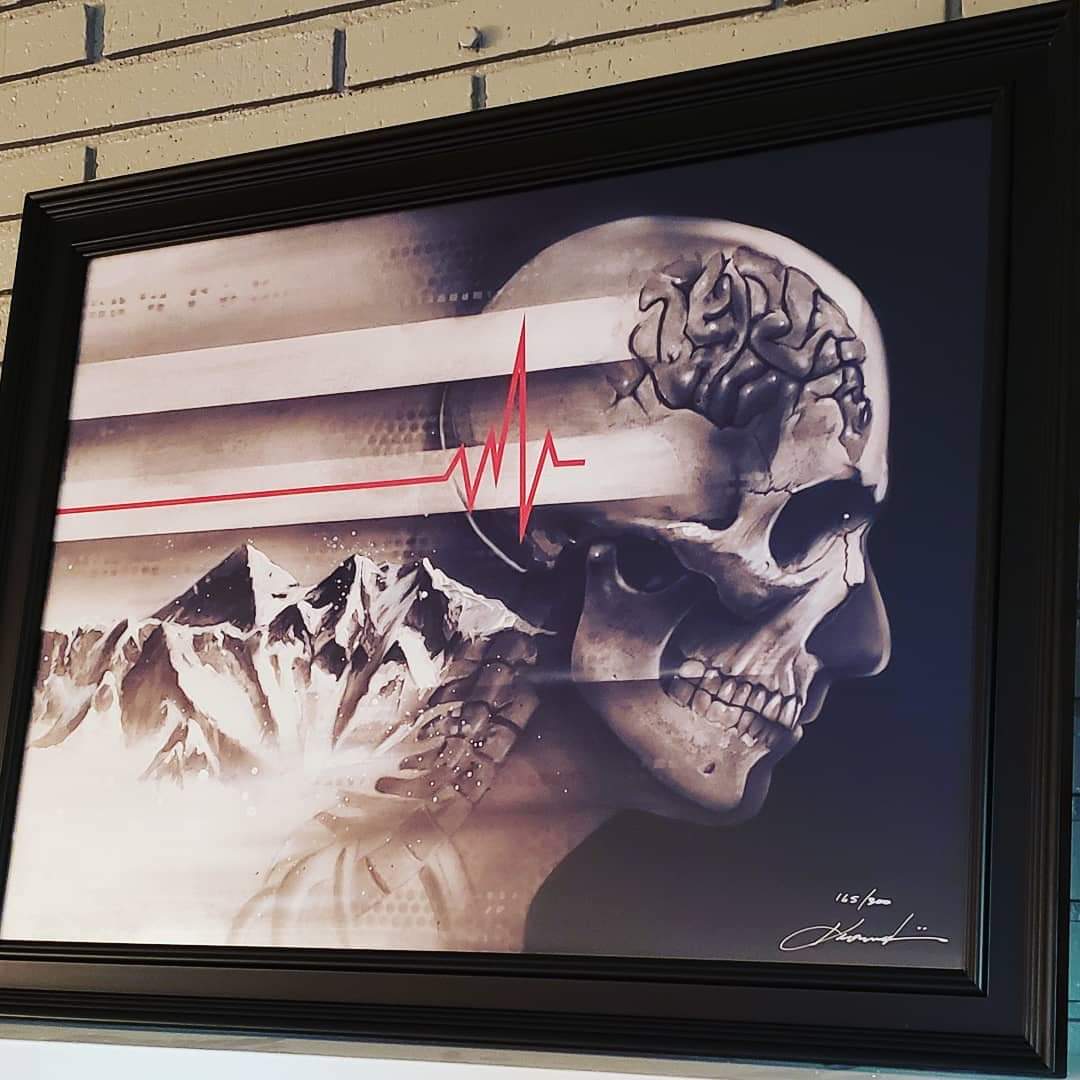
Ironically, I listened to this podcast shortly after I got around to framing a print I bought almost a year ago, after my visit to Haley Strategic Partners in Phoenix.
The print and Aprill’s comments about a #MeToo movement for mental health in gun culture took me back to my conversation with Travis Haley during that visit.
Haley freely admits that he suffers from a traumatic brain injury and PTSD, and his exploration of cognitive science — including understanding neural plasticity in the core of the central nervous system — surely has to do with his own struggles. This may be best represented in the Signature Series art work by Keomaka titled “My Fight” displayed in the showroom at HSP.
More needs to be done to publicize stories like Haley’s, and others like his, to help reduce the stigma of mental health issues in gun culture and in society at large.
“But,” Aprill recognizes, “it’s alot to ask because there’s so many people who think negatively about folks who do have a mental health history. But something’s gotta give. Sunlight is the best cure for stigma, but stigma is the thing that crowds out the light.”
NOTE: I am continuing to collect links to the many resources out there on gun owners, mental health, and suicide prevention. If you know of such a resource, please post it in the comments here or the Facebook cross-post of this blog entry.

 Gun Culture 2.0
Telling the world you have problems when there is a movement in this country to have laws where the police take away a troubled person’s guns sounds like asking for trouble for the person who talks.
LikeLiked by 1 person
Those who are concerned with suicide and are vehemently anti-gun are a big part of the problem.
LikeLiked by 3 people
Do we need more honest conversations in the firearms community about mental health issues? Absolutely. But let’s be honest. If law abiding gun owners start talking about their own mental health struggles and how they triumphed over the darkness, you can bet that the local “Mommies Against Guns” would literally “swat” them to the local authorities, if not just the local media. Is it better to keep a personal struggle under wraps or go public?
Mental health struggles among veterans from all conflicts are not being adequately addressed and only make it into the public conscious when a personal tragic event makes the news. Openly proclaiming that you have, or had PTS and/or a drug/alcohol/anger problem from your past traumatic experiences, and being a supporter of gun rights you are setting yourself up to be a target of the anti-gun left. You will be deemed a public health problem that needs to be eradicated.
The issues are well defined; we all know what they are because we keep recounting them over and over. Now, what are the solutions, or at least steps that might lead to some concrete solutions? I’m waiting.
LikeLiked by 1 person
I am working on compiling a list of known resources. Defensiveness on the part of gun owners, justified to some extent to be sure, has limited involvement. But I hope more can be done.
LikeLike
In a logical world, the fact of the matter is that most of those with past or present mental health problems spanning a wide range of diagnoses are non-violent. PTSD is such a generic term as well and doesn’t rise to the level of being a box to check on a 4473. Maybe we need more publicity, not less.
LikeLike
This was one of Aprill’s points – the 4473 is purposely written very narrowly. I highly recommend listening to his show.
LikeLiked by 1 person
Excellent webcast. Thanks for the advice.
LikeLike
[…] — but I was always most impressed by his ability to understand the human mind. Speaking with Paul Carlson on his Safety Solutions Academy podcast, Aprill talked about the benefits of having a #MeToo movement for mental health. He also showed his […]
LikeLike
[…] “A #MeToo Movement for Mental Health?” from 16 October 2018 […]
LikeLike