
Last year I began writing reviews of gun-related books for CHOICE, a publication of the Association of College & Research Libraries that helps academic librarians find new titles to add to their collections. The reviews themselves are only a couple hundred words long, so it’s tough to say anything substantive in them, but being a reviewer allows me to see and read some books I otherwise wouldn’t. Case in point: Debating Gun Control: How Much Regulation Do We Need?
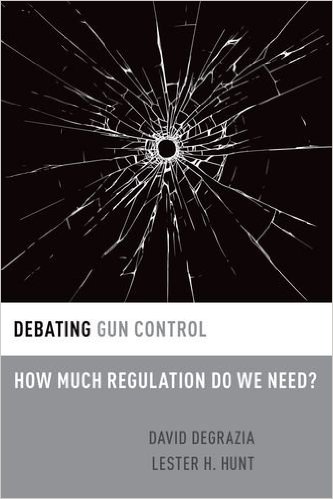
This book, part of Oxford’s Debating Ethics series, presents opposing moral views of gun control by two philosophers. In the 8 chapters of Part I, Lester H. Hunt of (my graduate school alma mater, the University of Wisconsin at Madison) offers “The Case Against.” The core of his argument is that gun ownership is a right that deserves special protection because it facilitates the fundamental right to self-defense. In a nutshell: “If there is a right to use force, including lethal force, in self-defense, then there is a right to own guns, including handguns” (p. 26).
In the 8 chapters of Part II, David DeGrazia (of George Washington University) argues “The Case in Favor.” His case for gun control rests on the negative social consequences of gun ownership in terms of public safety. He calls this “the consequentialist case” and it is based on the large number of intentional and unintentional injuries and deaths due to firearms.
The subtitle’s framing of the question of gun control as “how much regulation” is needed is most descriptive of the debate presented. Hunt’s anti-restrictionism advocates minimal but not no regulation. Similarly, DeGrazia characterizes his view of the level of morally justifiable regulation as “moderately extensive.” Because the two authors do not go back and forth from chapter to chapter, what is presented is not how many would imagine a debate, though there are implicit references to each other’s arguments in each of the two parts. Overall, two distinct and opposing ethical positions toward gun regulation are presented fairly clearly and persuasively.
I am going to get the most intellectual mileage from two particular passages:
A gun is a tool, a product of human technology; and like any technological device, it exists to solve problems. (p. 8)
To understand guns and their attractiveness to people, we need to understand what guns DO for people. Like helping solve the problem of thirst using a tactical bottle opener.

Also, like good philosophers, defining terms and making conceptual distinctions is a big part of this book. A significant distinction made by Hunt in his case against gun control is between punishment or deterrence of and defense against crime:
Punishment and deterrence of crime are functions of the law. Defense against crime – meaning by that phrase either self-defense or one agent’s active defense of another – are services of a fundamentally different character. . . . [T]he state and its legal system do provide punishment and deterrence and do not provide defense in my sense. (pp. 28-29)
Those who look to the criminal justice system to defend them from crime are barking up the wrong tree. The police, in particular, have a duty to provide “protection” only as a public good offered to all citizens through deterrence, not a duty to defend any particular individual. The consequence of this is significant:
Because the level to which [the police] provide this public good [of protection through deterrence] always falls short of perfection, in the sense that there will always be some crime and some consequent likelihood of suffering attack, some people will have good reason to make up some of the resulting deficit by taking defensive steps on their own. Those who take such steps are not poaching on territory that rightly belongs to the state and the law; they are doing something that the system has made very clear it has no obligation to do at all. (p. 30)
As Hunt himself recognizes, this gives philosophical rigor to the contemporary saying, “when seconds matter, the cops are only minutes away” (p. 31).
This is actually the perfect lead-in to some issues my students and I have been grappling with in my Sociology of Guns Seminar. Hopefully I can get to those here sooner rather than later.
 Gun Culture 2.0
As far as Prof. Hunt’s position against regulation, its not just about regulation as much as effectiveness. Owning a gun does not make one a competent armed citizen any more than owning a guitar makes me a musician. Practice, practice….
The flip side is that those who advocate for controls don’t often provide compelling evidence that the controls will do what they are advertised to do, i.e., reduce harm, while what they sometimes do is deter ownership.
Wish I was there in your class for this. Given that the Donks have taken over the legislature in New Mexico, we are held hostage to a bunch of gun bills.
LikeLiked by 1 person
David,
And entirely ignored by the consequentialists are the significant numbers of lives and injuries saved, and other violent crimes prevented.
Robb
Robert B. Young, MD Editor, DRGO.us
LikeLiked by 1 person
Meliora, Doc!
LikeLike
Defense in depth is a pretty common concept, as is deterrence. We put a lot more faith in nuclear deterrence than we put in our ability to shoot down any one missile should deterrence fail.
Likewise, defense in depth makes more sense than a single line of defense. One protects one’s home from fire by fireproofing the areas in and around the house, paying attention to the fire triangle rules, having zoning codes and preventive measures that protect the community against wildfire (a huge problem here in the West where wildfires can be catastrophic) and by funding an able fire department. Having fire extinguishers in various parts of the house are the last line of defense.
As far as crime, I would rather live in an area whose sociology and economy make crime rare, to have an effective criminal justice system that deters what few criminals might still exist (and the criminal justice system should deter criminals from arming themselves), and worry about the fire extinguisher last. As we all know, one never wants to get to the point of using the fire extinguisher. Literal or figurative.
How gun control fits into this bigger picture is the question I would ask. I see enough examples of poorly thought through gun control proposals that seek to control guns without a context or justification in terms of balancing social control against the amount of infringement they put on the citizen. The argument about what constitutes unjust infringement is a whole other topic. Let’s see if the SCOTUS revisits this.
LikeLiked by 1 person
Why we need the right to carry.
https://www.abqjournal.com/959461/deputies-involving-possible-attempted-carjacking-at-la-luz-trail-head.html
LikeLike
Law enforcement’s basic mission is to maintain public order to allow the citizens to go about there business without any more issue’s than the daily reality and to be secure in there possessions. All this “to protect and to serve” that IIRC was started by the LAPD back in the 1960’s is a public relations thing and that’s all. If your disturbing public order your in violation and subject to arrest. That simple. The baseline of modern gun control to me comes from the belief that you and I are not competent to defend ourselves. To hold the line till authorities can arrive.
I choose not to be a willing and willful victim.
Keep your powder dry and your faith in God.
LikeLike
[…] Ethical Arguments Against and For Gun Control: How Much Regulation Do We Need? (originally published […]
LikeLike
[…] Ethical Arguments Against and For Gun Control: How Much Regulation Do We Need? (originally published 2017, #6 in 2018). Not in my Top 100 best posts but here it is. Probably high […]
LikeLike
If all one cares about is minimizing the bad uses of guns, then no level of gun control is enough unless it succeeds in disarming the overwhelming majority of private citizens, because the potential for bad use is always present, and with hundreds of millions of citizens, even an unlikely bad event is, for all practical purposes, statistically inevitable.
No other answer is feasible unless one first addresses “Is there is a right to use force, including lethal force, in self-defense?” Legally, there has always been such a right. This has been based on Enlightenment Era philosophy. However, people who reject the political philosophy of John Locke (e.g. Marxists) will not necessarily agree. I believe that, at heart, the modern day gun control movement is motivated by just such a rejection. I believe the modern gun control movement is at heart motivated by the belief that the State should do its best to render ordinary private citizens incapable of killing in self-defense.
Whether there should be a right (in circumstances that the law has always recognized as “justifiable”) to kill in self-defense is an area of ethical confusion. I say “confusion” because those who would deny the right will make exceptions for agents of the State (e.g. police officers), but status as police is a distinction that is legal and political, not moral or ethical.
Some would cite Mahatma Gandhi as an ethical source, but I think they misinterpret his philosophy. I read his book, and while he did consider passive resistance morally superior to violent resistance, passive resistance to a robber would be a simple refusal to abide by his demands along with acceptance of death as a consequence. Gandhi argued that cowardly submission to oppression (e.g. submitting to a robber’s demands) was worse than violent resistance.
And I would add that the use of force (e.g. police) to force people to submit to oppression (via gun control) puts government (and the voters who chose that policy) in the role of the criminal or oppressor. Saying that a robber doesn’t deserve to die is like noting that we would not want the courts to impose permanent blindness as a punishment for rape. But a government that therefore tries to prevent robbery victims from killing in self-defense is like the rapist’s buddy who holds a woman’s arms down as she is raped — lest she succeed in using her sharp fingernails to blind the rapist. (Yes, the rapist’s buddy bypasses the opportunity to simply stop the rape, but a government that releases an unrehabilitated robber from confinement has bypassed the opportunity to stop the robber.)
The dictum “Better to free ten guilty than to convict one innocent” would be obscene if it were not accompanied by a robust right to self-defense.
LikeLike