
“While They Prey, We Pray: The Failure of Lockdown to Protect Students and Academic Personnel,” by Virginia Little and Anthony Vander Horst of Kent State University.
The main point of this paper was that lockdown has never been recommended by any security authority and yet is the accepted policy and practice in many schools. Lockdown as a defensive strategy was developed for use in prisons during riots and drive-by shooting situations outside schools. But in 95% of all school shootings, the shooter attended the school and so had ready access inside the school. Locking down under those conditions can simply create victims who are sitting ducks.
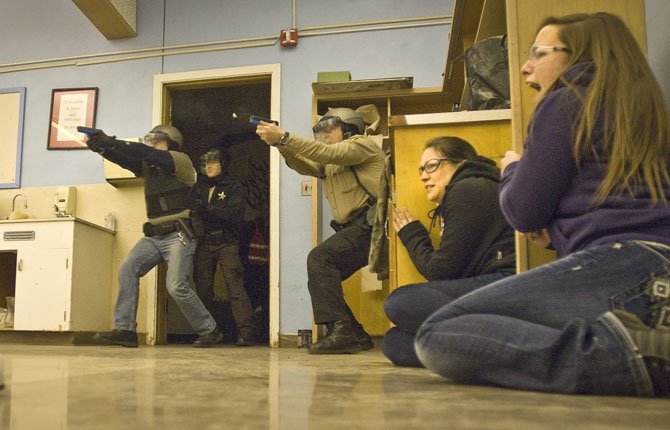
Thus, some school safety experts are promoting variations on the “run, hide, fight” strategy (which I have mentioned previously) as an alternative. Vander Horst and his colleagues are attempting to empirically evaluate the difference between traditional lockdown and the ALiCE (Alert, Lockdown, inform, Counter and Evacuate) Training Institute’s approach as a response to active killers in schools. Preliminary analyses based on simulations show a 54 percent reduction in the number of victims using ALiCE compared to traditional lockdown.
Beyond this, the entire issue of school shootings is of interest, not because it is common, but because it is so uncommon. And seemingly more random than the most common instances of homicide, which frequently follow very clear patterns (drugs, criminal activity, gang involvement). The traditional self-defense advice (summarized by trainer John Farnam) of “don’t go stupid places or do stupid things with stupid people” clearly does not apply to children going to school.
The very face of the mass shooter alone suggests there is something different about mass shootings than the average, everyday homicides that plague many communities in the US.
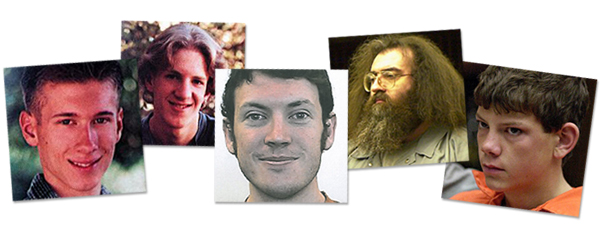
Vander Horst examines the 93 school shootings that took place in the period from 2000-2012. Of those, 11 (11.8%) were mass shootings according to the FBI definition of 4 or more victims not including the shooter. Of note is his finding that of the 11 mass shooting incidents, 7 (63.6%) were committed by individuals confirmed to be on Selective Serotonin Reuptake Inhibitor(s) (SSRIs).
(Side note: Vander Horst seems to have been very careful in determining SSRI use, as he did not include the Sandy Hook killer Adam Lanza as an SSRI user. Lanza had been prescribed the drug but it is not clear that he was using them at the time of the shooting.)
SSRIs are prescribed for a variety of conditions such as depression, psychosis, bipolar disorder, schizophrenia. Recent studies have suggested caution in prescribing SSRIs to juveniles due to increased suicide risk (there is even a subclass warning to prescribers of SSRIs to this effect). Since many school shooters are suicidal – 39% of the 93 school shooters in this study committed suicide – the SSRIs could be what pushes some of them over the edge. Of course, it is not clear whether the SSRIs have a causal role. Someone who shoots up a school is in a sense by definition mentally disturbed, so the SSRI might just be an indicator of this fact.

In any event, as reported by Vander Horst (reproduced in the table below), school shooters on SSRIs were responsible for almost half (46%) of all those killed in school shootings from 2000-2012, and 71% of those killed in mass shootings.
| SCHOOL SHOOTINGS 2000-2012 |
All Victims |
Killed |
Injured |
| All School Shootings |
456 |
158 |
298 |
| Mass School Shootings |
234 |
101 |
133 |
| Killer on SSRI Meds |
163 |
72 |
91 |
| Mass/All Shootings |
0.513 |
0.639 |
0.446 |
| SSRI/All Shootings |
0.357 |
0.463 |
0.305 |
| SSRI/Mass Shootings |
0.697 |
0.713 |
0.684 |
As we continue to seek explanations for the incomprehensible, this lead seems to have some potential. At the same time, we should be careful not to attribute too quickly a causal role to SSRIs, since the overwhelming majority of juveniles on SSRIs do not become mass murderers, in the same way that gun ownership does not cause the vast majority of gun owners to commit homicide.


Reblogged this on Brittius.com.
LikeLike
[…] about what I learned (about illegal guns and homicide, and gun ownership and risky behavior, and school shootings, and lessons from the United Kingdom, and who gets shot, and fear of crime, and regulation of ammo […]
LikeLike