
I shot two replica muzzle loaders yesterday at Colonial Williamsburg in Virginia.
I am guest lecturing on religion and guns and gun culture in two classes today at the College of William and Mary, so I drove up to Williamsburg yesterday. My host mentioned that Colonial Williamsburg opened a musket range in spring 2016. I am a bit embarrassed to say in retrospect that I didn’t immediately commit to the opportunity to fire a flintlock musket because of sticker shock: $119.
All those who weighed in on the issue insisted this was an opportunity not to be missed. They were right. I am not going to run out and buy a musket myself, any more than shooting a fully automatic rifle a couple of weeks ago made me want to one one of those. But both were experiences I am glad I had.
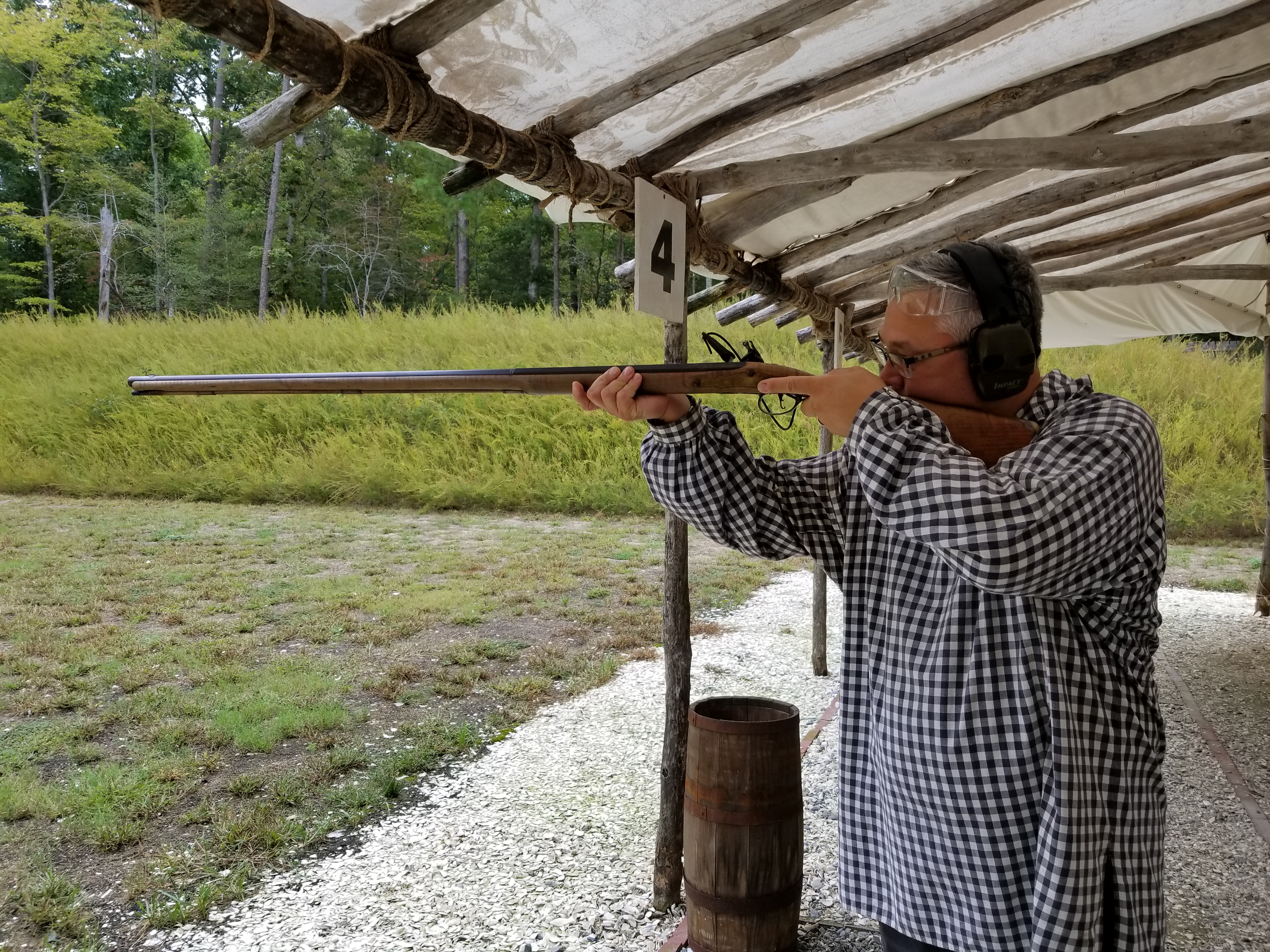
NOTE: I am not a technical gun guy, much less a historian of firearms, so if anything here is incorrect or in need of elaboration or clarification, please do so in the comments.
We had the opportunity to shoot two different muzzleloaders. One was a land pattern (as opposed to sea pattern) 72 caliber Brown Bess musket. This was described as designed as a military weapon. The other was a 62 caliber fowler (so named due to its common use in hunting fowl). This was described as the rifle more commonly owned by citizens for militia service. In the picture above, I am shooting the fowler and in the video the musket.

The guns of this era were FLINT LOCKS, which means the priming powder in the pan is ignited by striking a flint against a piece of metal (the frizzen) creating a spark. Pulling the trigger releases the hammer holding the flint accelerating it into the frizzen.

The priming powder then ignites and the flash in the pan goes through a small hole in the side of the barrel and ignites the gunpowder inside the barrel.
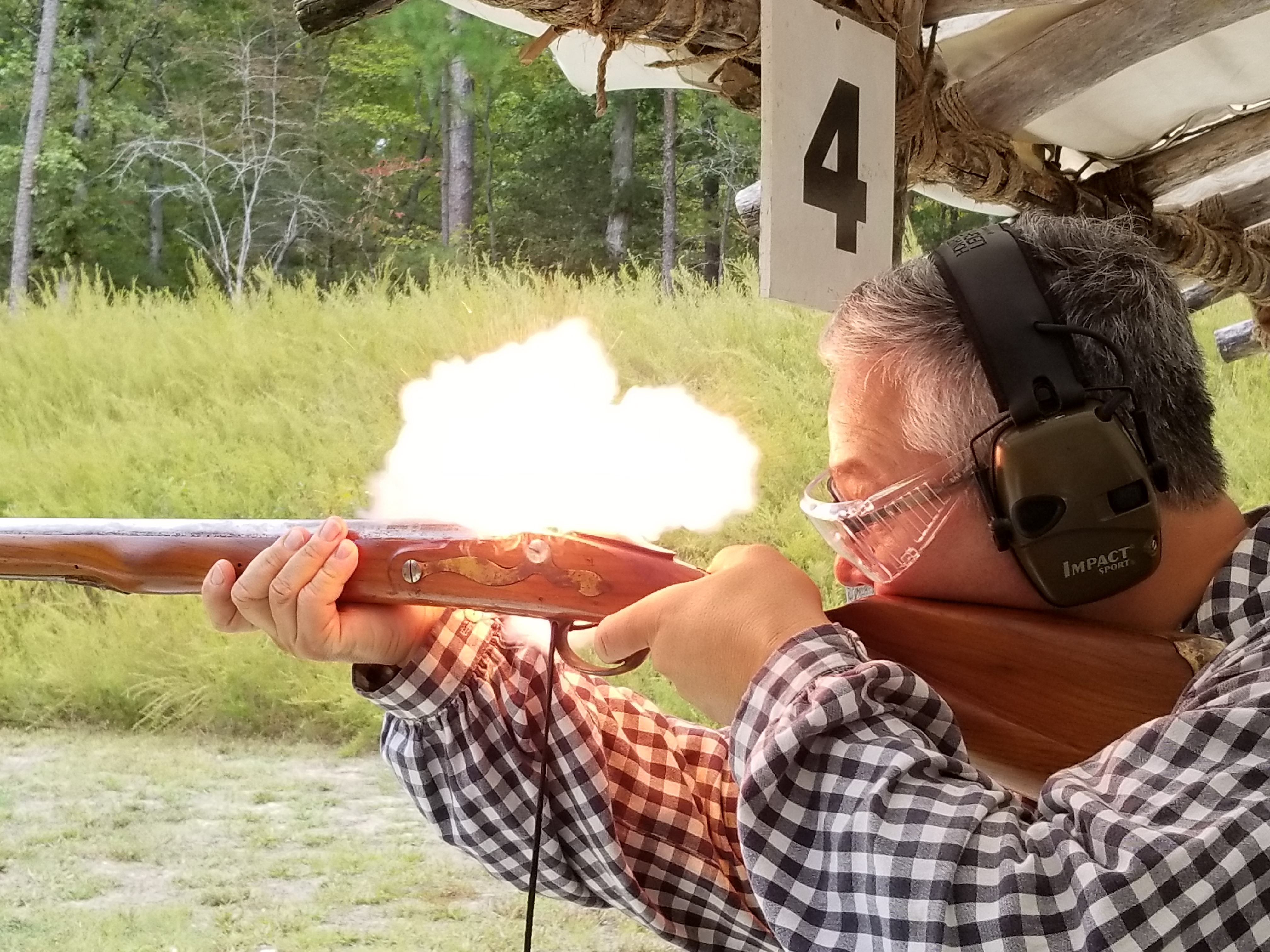
Igniting the gun powder in the barrel creates an explosion which forces the ball down the barrel, out the muzzle, and toward the target. Although the flash in the pan is pretty dramatic, these particular firearms did not have much recoil because (a) they are pretty heavy (the musket was just over 10 pounds), (b) they reduced the amount of gun powder used by about 1/2 because we were only firing on a 25 yard range, and (c) the balls used were smaller than the diameter of the barrel allowing some of the gas pressure to escape around the ball.

I was not allowed to load the gun (Katie is doing that in the picture above), but I was responsible for adding the priming powder to the pan, lowering the frizzen into place, cocking the hammer, and firing.
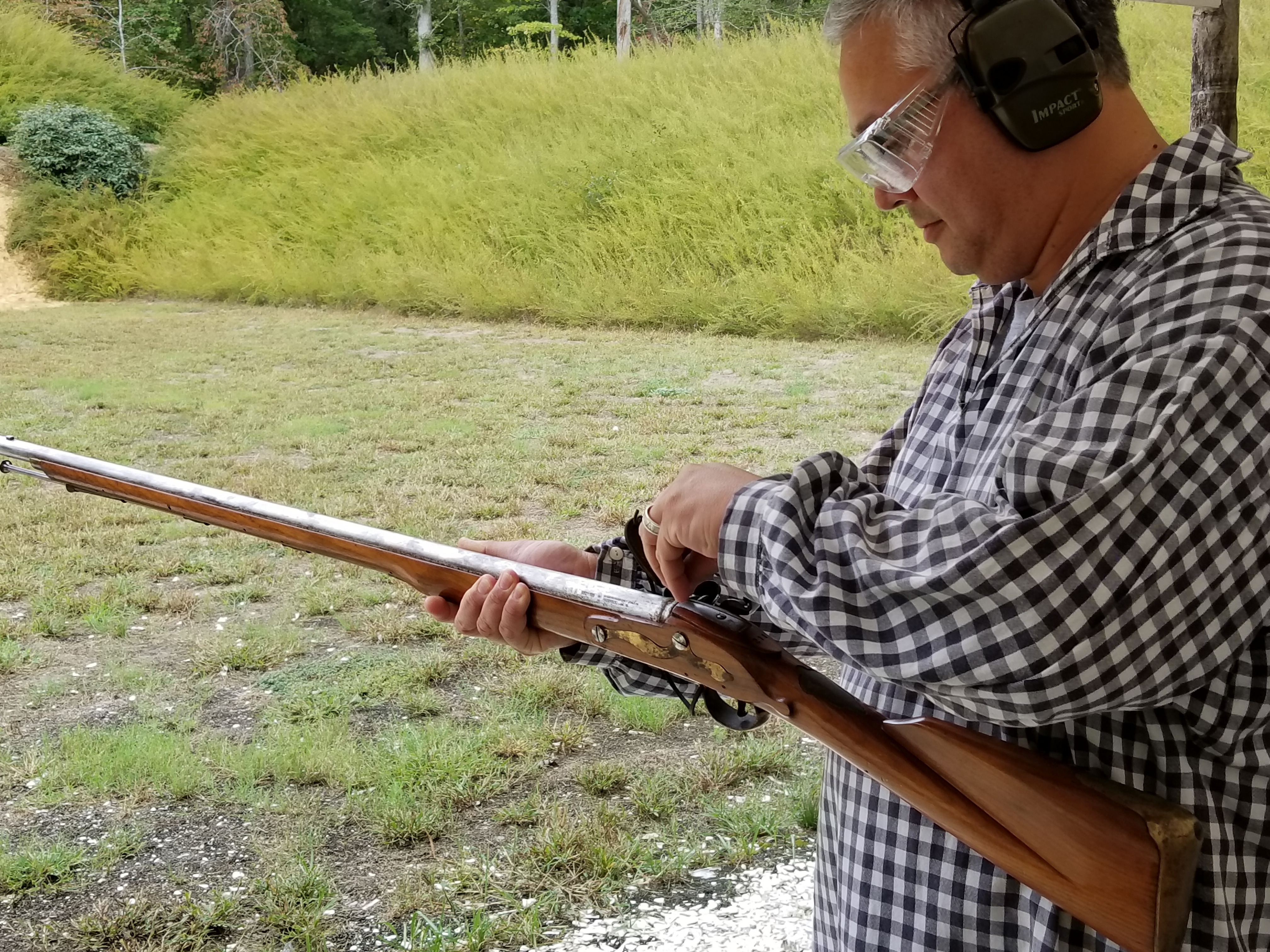
The replica muskets used at Colonial Williamsburg are built by the Italian gunmaker Davide Pederoli and the fowler by Jim Chambers Flintlocks of North Carolina.
A maximum of six people can participate in any of the one hour sessions (each person can bring one observer). I was the only one who signed up for my session, so I think I got to shoot more than most people: 7 shots with the musket and 7 shots with the fowler.

At 25 yards, I flinched and pulled the first shot with the musket off the target entirely. I pulled one other shot off the paper, but put my other 12 on the paper, including one bullseye (I was aiming every shot at the target in the center). I was happy with that, especially when one of the RSOs said that some shooters take home untouched targets.

I think with some practice I could graduate fairly quickly from the “awkward squad” — Jeff said this is the colonial military equivalent of today’s “human shields.”
I would be remiss if I didn’t mention the three person staff who run the range, all of whom are NRA certified instructors. Jeff explained the history and operation of the flintlock musk.
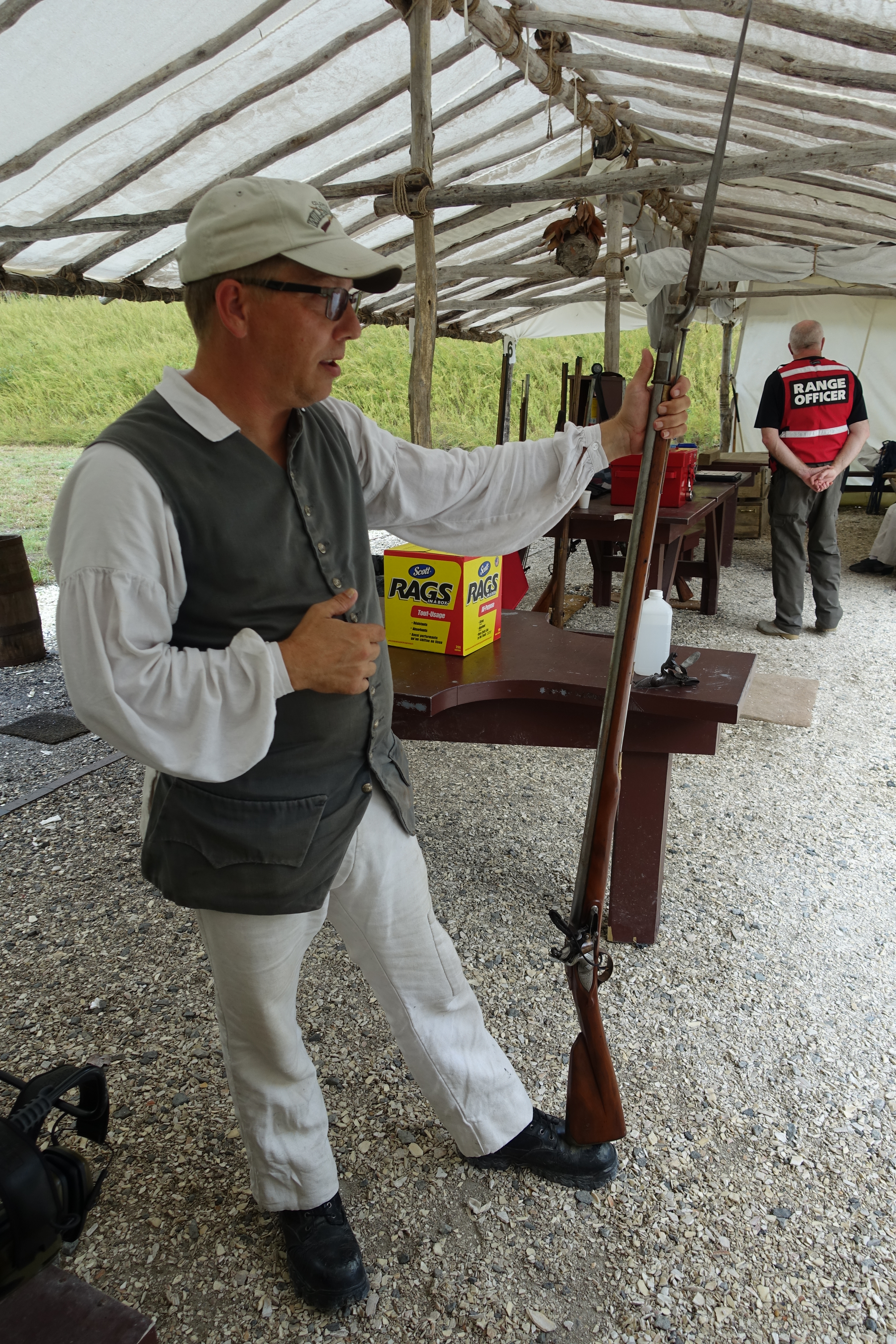
Jim acted as the chief RSO. As you can imagine, safety was emphasized from the beginning and throughout.
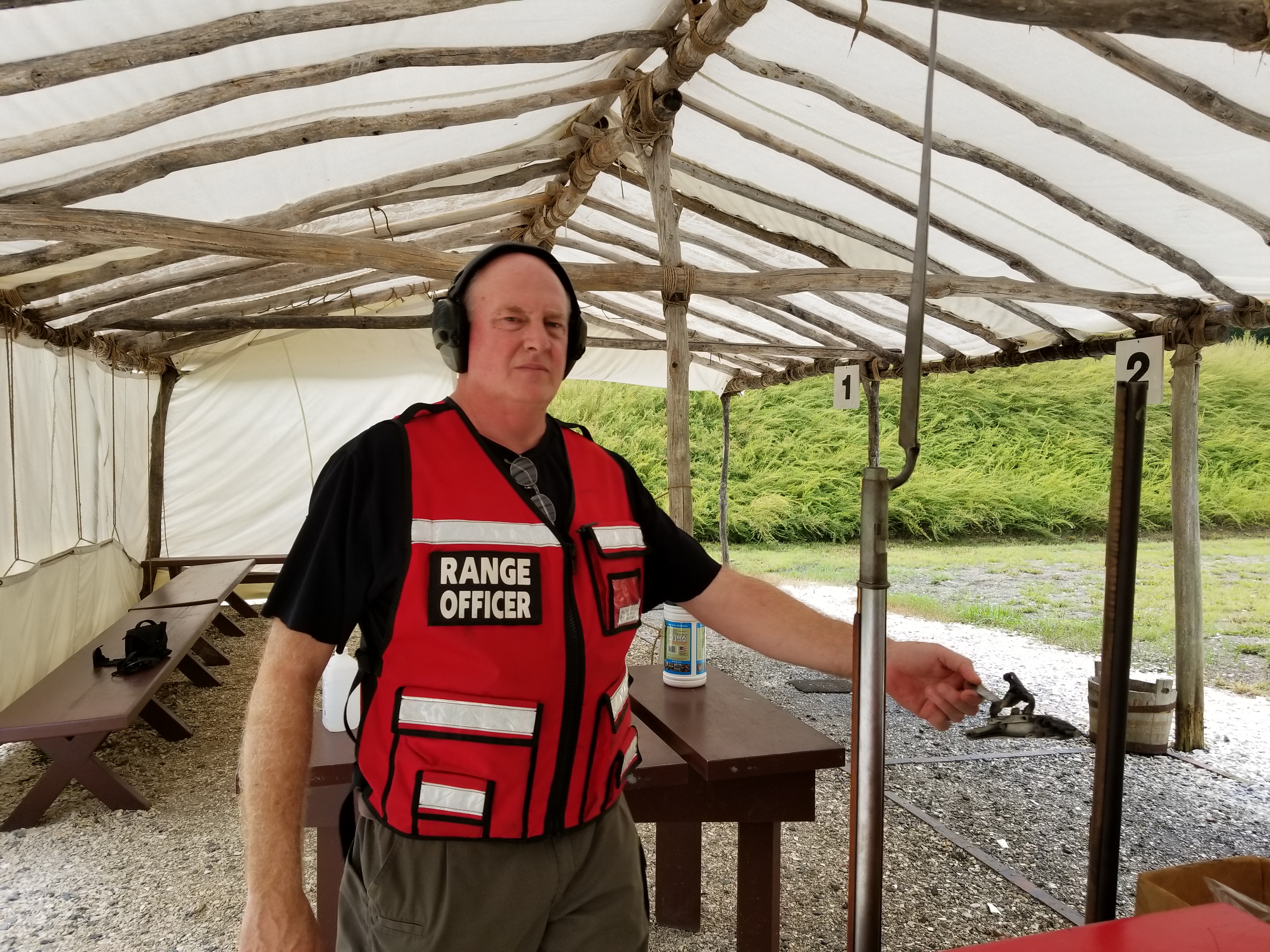
And Katie not only drove the shuttle but showed me how to fire the musket and did all of the loading.

All of them were extremely appreciative of my being there.

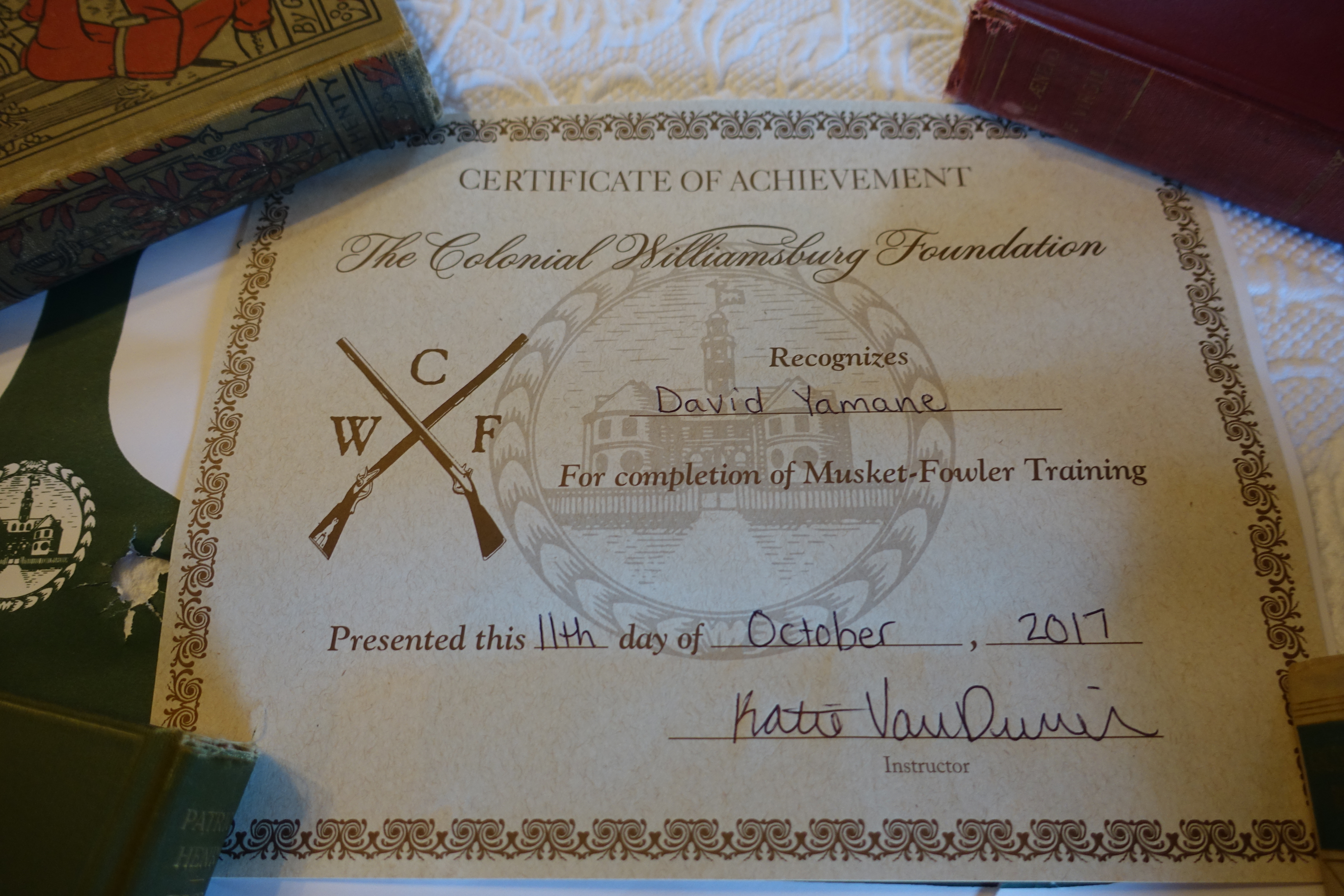
In addition to my target, I got a hand crafted pewter (not lead) ball to take home as a souvenir and a certificate of participation. $119 is obviously not cheap, but it was definitely money well spent.

Thanks to Ralph for the technical correction regarding my incorrectly referring to these arms as “rifles.” The barrels are smooth not rifled.
 Gun Culture 2.0
It’s an amazing program and I’m glad Colonial Williamsburg set it up.
LikeLiked by 3 people
What is the age limit? I have some nephews who might be interested and my mom is always up for Colonial village stuff.
LikeLike
“Each participant is allowed one observer. All observers must be age 12 or older. For participants ages 14 – 17, the observer must be a legally responsible adult.” So, 14 years old minimum.
LikeLiked by 1 person
We’ll have to plan a bit further out. Just realized I could have gone and looked online myself. Thank you for taking the time.
LikeLike
Reblogged this on and commented:
Grow a full beard, and you’re ready for a Mountain Man rendezvous.
LikeLiked by 1 person
Not as reliable as an AK /sarc
LikeLiked by 1 person
I did have one misfire
LikeLiked by 1 person
I like AR-platform rifles more than AKs. In their current form, just as reliable as AKs, more ergonomic, and these days are 75% the cost of an AK for a lot better(consistently) quality. You gotta look at an entry level AK for defects.
LikeLiked by 1 person
What was the nature of the misfire?
LikeLiked by 1 person
Misfire was due to dull flint not creating spark. They sharpened the flint and I was back in business.
LikeLiked by 2 people
There is something special about experiencing the technology of the past!
One small correction, both the Brown Bess musket and the fowler you fired were smoothbore firearms; as were most of the firearms in common use in the colonial era.
LikeLiked by 3 people
Ah, so not “rifles”?
LikeLiked by 1 person
Musket.
LikeLiked by 2 people
Thanks!
LikeLiked by 2 people
You’re welcome. Uh.., professor, get working on the beard. When you hold your hand straight to measure the length, it should cover the knuckles, then you are ready. Mountain Man Professor. Your wife can knit a red cap. It doubles as a foraging bag.
https://en.wikipedia.org/wiki/Centennial_(miniseries)
https://www.google.com/search?q=pasquinel&rlz=1C1CHMO_enUS652US652&source=lnms&tbm=isch&sa=X&ved=0ahUKEwjZtq_UoezWAhVGyoMKHaLBAHQQ_AUICigB&biw=1067&bih=529
LikeLiked by 1 person
Alas, sir, I am sadly unable to produce sufficient facial hair for a beard. I have tried to grow a mustache and goatee on occasion and after two weeks without shaving I just look ridiculous.
LikeLiked by 1 person
I learned everything I know about muzzle-loaders from Looney Tunes.
LikeLike
Shit I love looney tunes. Remember when Tweety had a jet powered cage?
LikeLiked by 1 person
Looks like a PSA from the Brady Campaign.
LikeLiked by 2 people
Welcome to the club. I have owned a .50 Hawken percussion rifle since I was 16. Since it is a rifle does have a bit more shoulder punch. In the 1990’s a friend and I looked into ACW re-enacting. He bought a replica 1861 Colt and I got a 1858 Remington. Both in .44 cap and ball. We went out shooting a couple of times and it was great fun. Lots of smoke of course. And the best part of course is after you get home washing the pistol in hot water and soap and then baking the parts in the oven to get all the water out.
LikeLiked by 1 person
Too many hobbies already!
LikeLiked by 1 person
Glad you’re out of the Awkward Squad, professor!
I believe you’re familiar with Lt.Col.Dave Grossman’s work (‘On Killing’ and other books).
Describing our aversion to same-species killing he recounts studies of Civil War muskets being found on the battle field loaded with upwards of 15 balls in the barrel. …possibly indicating the desire to look busy about the business at hand but reluctance to fire. He speaks of even lower battlefield kill-rates via bayonet (Napoleonic battles are cited) because of the greater ease of detaching one’s self from killing when the enemy is further away.
Until better (relative term!) training was implemented, he says firing rates could have been as low as 15%.
Between that and the awful marksmanship capabilities of non-rifled barrels it’s a wonder anyone was shot.
Was any mention of accuracy or soldiers’ willingness to pull the trigger (v. intentionally aiming over the enemy’s head or overloading and never firing) mentioned by the museum staff?
Love the blog, sir. This looks like it was a great experience.
LikeLiked by 1 person
We talked a little about accuracy but mostly in the context of my shooting and being able to hit the target most of the time but all over the target rather than a tight group. The issue of the accuracy of the gun vs. the intentions of the soldiers who used them were untouched. Not that they would have avoided the topic if asked. They were all so enthusiastic about it they may have welcomed the question. Obviously from the responses I have gotten to this post, there is alot of passion and interest in historic firearms and the history behind them.
LikeLiked by 2 people
There are soooo many rabbit holes in Gun Culture. Don’t suppose you are familiar with the term “boolits?” That’s a whole nother realm.
LikeLike
Not familiar. And from the sound of it, I’m not sure I want to familiarize.
LikeLike
Perfectly safe, just an esoteric, and historically relevant, pastime with enthusiastic proponents.
LikeLike
[…] I had to pick a single most memorable moment for the year 2017 it would have to be shooting a replica musket at Colonial Williamsburg in Virginia. I also had a chance to shoot a suppressed, full-auto AR-style rifle for the first […]
LikeLike